


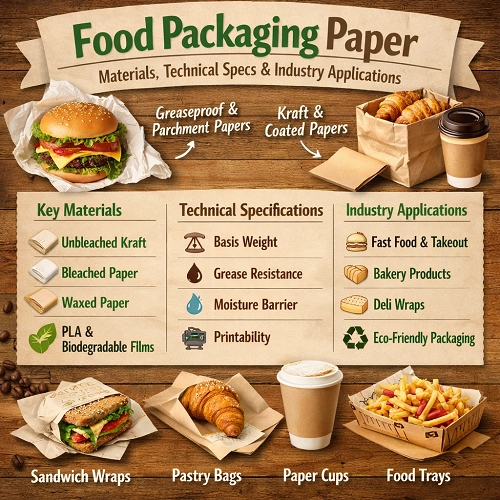
Food Packaging Paper: Materials, Technical Specs & Industry Applications
Food packaging paper is no longer a commodity afterthought. As global supply chains tighten and consumer expectations for labeling accuracy, food safety, and sustainability rise, the choice of paper substrate has become a strategic decision for brand owners, food manufacturers, and logistics operators alike.
"The right paper substrate protects the product, carries the brand identity, and satisfies the regulator — all at once."
What Is Food Packaging Paper?
Food packaging paper encompasses a broad family of paper-based substrates engineered for direct or indirect contact with food products. Unlike standard industrial paper, food-grade variants must meet strict criteria around chemical migration, grease and moisture resistance, printability, and mechanical durability. The substrate market divides broadly into uncoated commodity grades and high-performance functional papers — the latter being the focus of leading manufacturers like Zhejiang Wanbaolong Adhesive Products Co., Ltd.
At the product level, food packaging paper serves dual roles: primary packaging (in direct contact with food) and secondary labeling (affixed to outer cartons, bottles, or trays). Both categories carry their own technical demands, which is why substrate selection is best approached systematically rather than by price alone.
Surface Material Categories
The Paper Series Products offered by WBL span six principal surface materials, each optimized for distinct performance profiles:
| Surface Material | Key Properties | Typical Applications | Print Method |
|---|---|---|---|
| Glossy Coated Paper | High sheen, excellent ink holdout, smooth surface, good stiffness | Food labels, wine labels, premium retail | Offset, flexo, digital |
| Semigloss Paper | Moderate sheen, reduced glare, balanced ink absorption | Daily chemical labels, supermarket shelf tags | Offset, UV flexo |
| Offset Paper | Matte finish, natural feel, high bulk-to-weight ratio | Office labels, clothing tags, medical labels | Offset, inkjet |
| Kraft Paper | Brown or white, high tensile strength, eco-friendly aesthetics | Artisan food packaging, bakery, organic brands | Flexo, letterpress, digital |
| Aluminum Foil Paper | Barrier to moisture, oxygen & light; metallic finish | Snack packaging, cold-chain labels, specialty food | Flexo, hot-stamp |
| Fluorescent Paper | High visibility, UV-reactive, vibrant base colors | Promotional food labels, shelf-edge tags, industrial | Flexo, screen |
Technical Specifications in Detail
Grease & Moisture Resistance
Food applications — from burger wrappers to deli labels — frequently expose packaging paper to oil and water. Grease resistance is measured by the KIT test (TAPPI T-559), where a score of KIT 8–12 is generally required for direct food-contact wraps. Moisture resistance is addressed through either a PE (polyethylene) coating applied to the base paper or an integrated wax layer. WBL's PE Coated Paper Series provides a fully sealed barrier suitable for wet and greasy foods without sacrificing label printability.
Adhesive Compatibility
Self-adhesive label stock requires the face material, adhesive, and release liner to work as a system. Acrylic pressure-sensitive adhesives (PSAs) dominate food label applications due to their broad temperature range (typically −40 °C to +120 °C) and clean removal from glass and PET. WBL's paper-series face stocks are pre-coated to ensure consistent adhesive laydown and peel strength, reducing converter waste and improving machine runnability.
Caliper & Grammage
Grammage (g/m²) and caliper (thickness in micrometers) directly affect stiffness, die-cutting precision, and dispensing performance on automated label applicators. The table below summarizes typical specification ranges for each surface material type:
| Material | Grammage (g/m²) | Caliper (µm) | Stiffness (MD, mN) | Recyclability |
|---|---|---|---|---|
| Glossy Coated | 60 – 120 | 65 – 130 | Medium–High | Recyclable |
| Semigloss | 55 – 100 | 60 – 115 | Medium | Recyclable |
| Offset | 50 – 90 | 70 – 120 | Medium | Recyclable |
| Kraft | 70 – 150 | 90 – 180 | High | Recyclable & Biodegradable |
| Aluminum Foil | 80 – 200 | 100 – 220 | High | Specialty stream |
| Fluorescent | 60 – 100 | 65 – 115 | Medium | Recyclable |
Industry Applications
The breadth of applications for food packaging paper reflects its versatility. WBL's Paper Series supplies converters and brand owners operating in virtually every sector of the food industry:
Key Application Verticals
- Bakery & Fresh Produce — Kraft and offset papers for artisan branding and natural aesthetics
- Beverages & Wine — Glossy and semigloss labels for high-resolution print and moisture resistance
- Processed & Packaged Foods — Full-barrier aluminum foil labels for freshness and shelf life
- Frozen & Cold-Chain — Low-temperature PSA on coated stock for reliable adhesion
- Supermarket & Retail — Fluorescent and semigloss for shelf-edge pricing and promotions
- Medical & Nutraceuticals — Offset paper meeting pharmaceutical-grade legibility standards
- Industrial Food Equipment — Durable labels cross-linked with film-based substrates
Surface Color & Finish Options
Color selection in label paper is not purely aesthetic — it carries functional implications for ink contrast, barcode readability, and consumer perception. WBL's Paper Series is available across a comprehensive color palette:
| Color / Finish | Ideal Ink Colors | Barcode Contrast | Common Use |
|---|---|---|---|
| White Most popular | All colors | Excellent | Universal food label |
| Brown (Natural Kraft) | Dark inks preferred | Good | Organic & artisan brands |
| Bright Gold / Dull Gold | Black, dark navy | Moderate | Premium wine & spirits |
| Bright Silver / Dull Silver | Black, dark inks | Good | Health & pharma labels |
| Red / Yellow / Orange / Green | White, black | Variable | Promotional & fluorescent tags |
Sustainability & Regulatory Compliance
Regulatory frameworks governing food-contact paper have tightened considerably. In the United States, the FDA regulates food-contact substances under 21 CFR; in the European Union, Regulation (EC) No 1935/2004 sets the overarching framework, with specific measures for paper under development. Key compliance requirements for modern food packaging paper include:
| Compliance Area | Standard / Regulation | What It Governs |
|---|---|---|
| Food Safety (USA) | FDA 21 CFR Part 176 | Permitted substances in food-contact paper & paperboard |
| Food Safety (EU) | EC 1935/2004 + BfR recommendations | Migration limits, inert material requirements |
| Heavy Metals | EN 71-3, REACH | Restrictions on lead, cadmium, chromium in inks & coatings |
| Recyclability | CEPI / EPPA guidelines | Label removability, fiber repulpability |
| Sustainable Forestry | FSC / PEFC certification | Chain-of-custody for virgin fiber sourcing |
WBL's food packaging paper is manufactured from high-quality, food-grade materials that align with international food-safety standards, and the company's broad material portfolio — including kraft and uncoated stocks — supports customers pursuing 100% recyclable and biodegradable packaging goals.
Printability & Customization
Modern food brands require label substrates that accommodate a range of print technologies without re-engineering the production line. WBL's paper-series face stocks are engineered for compatibility with:
Print Technology Compatibility
- Offset Lithography — Ideal for large-run food labels with consistent color gamut
- Flexographic Printing — Dominant in self-adhesive label production; water-based or UV inks
- Digital (Inkjet & Laser) — Variable data printing for batch codes, best-before dates, QR codes
- Thermal Transfer — Barcode and traceability labels on coated stock via ribbon
- Hot Stamping — Metallic effects on foil papers for premium wine & spirits
For variable-data requirements — such as sequential serial numbers, expiration dates, or personalized promotions — WBL also offers a dedicated Variable Information Printing product line, enabling high-speed, on-demand data encoding across all paper substrates.
Why Source from Zhejiang Wanbaolong?
Zhejiang Wanbaolong Adhesive Products Co., Ltd. was founded in 2005 and has grown into one of Asia's foremost label material manufacturers. Operating from a 60,000 m² facility in Haining, Zhejiang — strategically positioned between Shanghai and Hangzhou — the company employs over 300 professionals, including more than 60 chemical engineers, materials scientists, and technical specialists.
Key manufacturing capabilities include:
| Capability | Detail |
|---|---|
| Annual Output | Over 700 million square meters of label material |
| Production Lines | 50+ automated lines — film laminators, silicone coaters, coating machines, slitters |
| Product Categories | 200+ SKUs across film, paper, foil, and specialty substrates |
| Global Reach | Partnerships in 80+ countries and regions |
| Industry Experience | 20+ years of adhesive material R&D and manufacturing |
The full product ecosystem — from Lightweight Film Series and Durable Film Series to Special Paper and PE Coated & Silicon Paper — means converters can consolidate supplier relationships without sacrificing material diversity. Explore the complete factory capabilities and WBL's global distribution network for more information.