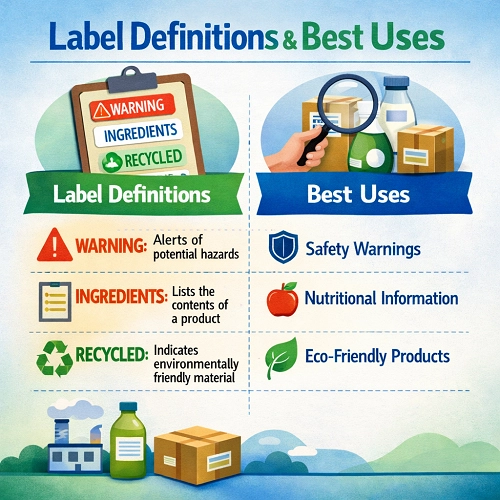



Label Definitions and Best Uses
Labels may seem insignificant, but they are powerful tools for conveying important information. From product packaging to organizational systems, self-adhesive labels have become an indispensable part of everyday life worldwide. In fact, it's safe to say that self-adhesive labels have revolutionized the way we brand, organize, and communicate.
What are Self-Adhesive Labels?
Self-adhesive labels, also known as pressure-sensitive labels, are labels that adhere to a surface with the application of pressure. Self-adhesive labels offer numerous advantages. They are easy to use and versatile, working on a variety of materials, including glass, plastic, metal, and cardboard. Self-adhesive labels can also be custom printed with text, graphics, barcodes, or QR codes.
Different Types of Self-Adhesive Labels
Self-adhesive labels typically come in two types: permanent and removable. Removable labels can be easily peeled off without leaving residue or damaging the surface. They are often used for applications where only temporary labeling is needed, such as price tags, promotional stickers, or temporary organizational labels.
Permanent labels are designed to remain securely in place for extended periods. Once applied, these self-adhesive labels form a strong bond with the surface. While they can be removed, the removal process usually damages the label or the surface. Permanent labels are commonly used for product labeling, branding, and identification.
Large Self-Adhesive Labels
Large self-adhesive labels are designed to provide ample space to showcase your information or brand identity. Large self-adhesive labels allow you to include more information or make your design clearly visible even from a distance. They are excellent tools for branding or promotional campaigns, allowing you to prominently display your logo or marketing message. They can also be used to display safety instructions, multilingual translations, or product information. From marking large containers or equipment to creating eye-catching displays, these labels offer an easy way to create visually impactful communication.
How They Are Made
Self-adhesive labels are primarily composed of three parts: the face stock (or label material), the adhesive, and the release liner. The face stock is the visible part of the label that carries the design and printed information. The face stock can be made from a variety of materials, such as paper, vinyl, polyester, or even specialty materials like metallic foil.
Once the face stock is selected, the adhesive is applied to the back of the face stock. The adhesive is what allows the self-adhesive label to adhere to various surfaces. There are many types of adhesives available, and the appropriate adhesive depends on your labeling needs. After applying the adhesive, a release liner is attached. The release liner is a backing material that protects the adhesive layer until the label is ready for use. It is typically a silicone-coated paper or film that can be easily peeled off to allow for label application.
Best Uses
Due to their versatility, self-adhesive labels are used across various industries.
Here are some of the best uses for self-adhesive labels:
- Product Labels: Self-adhesive labels provide a professional way to display product information and branding.
- Organization Systems: From offices to warehouses, self-adhesive labels are invaluable in creating efficient organization systems. They can be used to label storage containers, files, shelves, drawers, and more.
- Branding and Marketing: Self-adhesive labels are excellent for branding and marketing. They can be used on promotional materials, merchandise, retail displays, and event signage. Large self-adhesive labels are particularly effective for creating eye-catching displays.
- Healthcare: In the medical and pharmaceutical industries, self-adhesive labels are crucial for labeling medications, providing patient identification, and tracking samples.
- Pricing: Many retail stores use self-adhesive labels for pricing products.
- Shipping: Most shipping and logistics companies use self-adhesive labels in their operations. These labels are used for address labels, barcodes, tracking numbers, and handling instructions.
When Not to Use Self-Adhesive Labels
While there are many benefits to using self-adhesive labels and they are suitable in many situations, there are some cases where you might need to look for alternative labeling methods.
Here are some situations where self-adhesive labels may not be the best option:
- High-Temperature Environments: In extreme high-temperature environments, the adhesive used in these labels may fail, causing the labels to peel off.
- Rough or Uneven Surfaces: Self-adhesive labels may not adhere well to rough, porous, or uneven surfaces.
- Curved or Complex Surfaces: Self-adhesive labels may not be suitable for curved or complex surfaces. The rigidity of the material and the inability of the adhesive to conform to irregular contours can lead to poor adhesion or bubbling.