


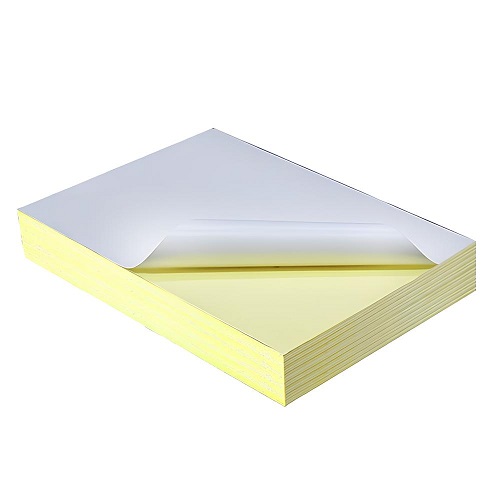
Adhesive sticker paper looks simple from the outside — face stock, adhesive, release liner — but the way those three layers are engineered determines whether a label survives a warehouse shelf, a bathroom mirror, or a freezer aisle.
What Adhesive Sticker Paper Actually Is
Adhesive sticker paper is a three-layer laminate: a printable face stock (paper or film), a pressure-sensitive adhesive coating, and a silicone-coated release liner that protects the adhesive until you're ready to apply it. Because the face stock is printable, it lets you go from a digital design to a finished, self-adhesive label without outsourcing die-cutting or lamination — which is why it's the default choice for short-run labeling, packaging, crafting, and product branding.
Core Properties That Determine Performance
Four variables decide how a sticker paper performs once it leaves the printer:
- Adhesive chemistry — acrylic adhesives resist UV and temperature swings better than rubber-based adhesives, which bond faster but degrade sooner outdoors.
- Face stock finish — matte finishes resist glare and take ballpoint pen well; glossy finishes maximize color saturation for retail packaging; transparent stock lets the substrate color show through the design.
- Printer compatibility — laser printers fuse toner with heat, so the coating must tolerate that heat without warping; inkjet stock needs a coating that absorbs ink quickly to avoid smudging.
- Environmental resistance — moisture, UV exposure, and temperature cycling all affect how long the print stays legible and the adhesive stays bonded.
Comparing Adhesive Sticker Paper Types
The table below compares the main sticker paper constructions manufactured by WBL, based on the specifications listed on the Adhesive Sticker Paper product page.[1]
| Finish Type | Best For | Printer Type | Surface Adhesion | Water Resistance |
|---|---|---|---|---|
| Matte | Product labels, office use, writable stickers | Inkjet & laser | Paper, plastic, cardboard | Moderate |
| Glossy | Retail branding, decorative stickers | Inkjet & laser | Paper, plastic, glass | Moderate |
| Transparent | Glass jars, branded windows, premium packaging | Laser (typically) | Glass, plastic, metal | Good |
| Durable film-based | Outdoor labels, industrial equipment | Laser & thermal transfer | Metal, plastic, glass, cardboard | High / weather-resistant |
WBL manufactures each of these constructions across dedicated product lines — see the Paper Series Products, Special Paper Series Products, and Durable Film Series Products ranges for full specifications.
How to Choose the Right Sticker Paper
Match the construction to where the label will actually live, not just how it looks on screen:
- Indoor, short-term use (event labels, gift tags): standard matte or glossy paper stock is sufficient and cost-effective.
- Product packaging that customers handle: choose a smudge-resistant, tear-resistant paper with strong initial tack so labels don't lift during shipping.
- Outdoor or high-moisture environments (bottles, drums, cold-chain packaging): move to a film-based or water-resistant construction rather than uncoated paper.
- Curved or textured surfaces: thinner, more flexible film stock conforms better than thicker paper stock, which can lift at the edges.
Printing and Application Best Practices
Two failure points cause most sticker complaints, and both are avoidable:
- Toner or ink not curing properly — confirm your printer's heat settings match the stock (laser stock is rated for fuser heat; inkjet stock is not). Mismatching the two causes smearing or scorching.
- Poor surface preparation — adhesive bonds fail most often because the application surface has dust, oil, or moisture on it. Clean and fully dry the surface, then apply at room temperature; adhesives generally need 24–48 hours to reach full bond strength.
For die-cutting, sharper blades and slower cutting speeds preserve clean edges on both paper and film stock, and reduce adhesive residue buildup on cutting mats.
Sustainability Considerations
Biodegradable and recyclable paper stocks are now widely available and perform comparably to standard stock for indoor applications, making them a reasonable default unless a project specifically requires film-level durability. If your brand has sustainability commitments, it's worth specifying recyclable liner and face stock at the sourcing stage rather than substituting later, since adhesive formulations differ between recyclable and standard lines.
About Zhejiang Wanbaolong Adhesive Products Co., Ltd.
WBL Label manufactures adhesive sticker paper alongside a broader range of film and specialty label materials, including Lightweight Film Series, PE Coated Paper & Silicon Paper Series, and Variable Information Printing stock. Production runs across the company's factory base, with distribution through a global network of partners. You can learn more about the company's background on the About Us page, or browse the full catalog on the Product page.
Need help specifying material? WBL's technical support team assists with adhesive type selection, printing consultation, surface preparation guidance, and custom sizing.
Phone: 0086-0573-8789 5888 | Email: wbl.fred@gmail.com | Contact Us
Frequently Asked Questions
Can adhesive sticker paper go through a laser printer?
Yes, provided the stock is rated for laser printing — the coating must tolerate the fuser's heat without warping or releasing the adhesive prematurely.
Will sticker paper survive outdoors?
Standard paper stock is not recommended for prolonged outdoor exposure; a water- and UV-resistant film-based construction is the better choice for that use case.
How long does the adhesive take to fully bond?
Initial tack happens within seconds, but most acrylic adhesives need roughly 24–48 hours at room temperature to reach maximum bond strength.