
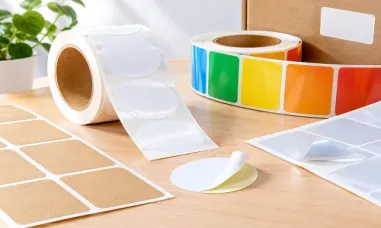
Self Adhesive PET Materials: How to Choose the Right Polyester Label Stock for Heat, Chemicals and Curved Surfaces
What Self Adhesive PET Material Is, and When It Beats PP and PVC
PET is a stiff, dimensionally stable thermoplastic. Its glass transition temperature is roughly 70–80°C and it melts at about 250–260°C, so a PET face film keeps its shape in conditions where lower-melting films distort. That stability matters more in labeling than the headline "durable" claim suggests. A label that shrinks even slightly during heat exposure will lift at the edges or distort its barcode.
PET is not always the right answer, though. Its stiffness is its biggest weakness on tight curves and squeezable containers. The table below shows where each film fits.
| Property | PET | PP / BOPP | PVC |
|---|---|---|---|
| Stiffness | High | Medium | Low (conformable) |
| Heat dimensional stability | Excellent | Moderate | Moderate, can shrink |
| Chemical and solvent resistance | Very good | Good | Fair |
| Squeeze bottles and tight radii | Poor to fair | Good | Very good |
| Tear and scratch resistance | Excellent | Good | Good |
| Typical best use | Industrial, electronics, outdoor, asset tags | Food, personal care, squeezable packs | Decals, curved or irregular surfaces |
Looking at polypropylene instead? See our guide to self adhesive PP materials.
Decision 1: Pick the Face Film Finish for the Job
The finish decides how the label looks, how it prints and what it can be used for. Wanbaolong supplies the following PET grades, each with its own product page.
| Finish | Best for | Watch out for |
|---|---|---|
| Glossy White PET (Coating) | Product labels, cosmetics, industrial and rating labels | Fingerprints show on gloss; test varnish or overlaminate if handled often |
| Transparent PET (Coating) and Transparent PET | "No-label look" on glass or plastic, labels over printed graphics | Air bubbles and adhesive flaws are visible; the background affects print contrast |
| Bright Silver PET and Bright Silver PET (Coating) | Premium and metallic-effect labels, equipment nameplates | Scratches show; confirm ink and ribbon adhesion on the metallized side |
| Matt Silver PET and Matt Silver PET (Coating) | Technical labels where glare hurts scanning or reading | Matt surfaces can mark under abrasion; check scan contrast for barcodes |
| Bright Gold PET Paper | Decorative and gift packaging | Decorative use; confirm durability needs before choosing it for harsh service |
Browse the full range under Durable Film Series Products and Lightweight Film Series Products.
Decision 2: Match Thickness to the Surface, Not Just Durability
Thicker PET is more durable, but it is also stiffer. A stiff film on a small-radius curve stores spring-back energy that works against the adhesive. This is the main cause of "flagging", where the label edge slowly lifts. Label-grade PET face films commonly run from roughly 36 to 100 µm. For reference, our Glossy White PET (Coating) page lists 50µm to 200µm, with customizable width.
Practical rule: Start with the thinnest film that meets your abrasion and handling needs, then test it on your real container or part. Do not choose a thick film for "extra safety" on a curved surface. Thicker film often makes adhesion worse there.
Decision 3: Choose the Adhesive for the Surface and the Temperature
The face film often gets all the attention, but the adhesive decides whether the label stays on. Three questions narrow the choice quickly:
- What is the surface? Glass and metal are easy. Low-surface-energy plastics such as polyethylene and polypropylene need a high-tack adhesive. Powder-coated, oily or textured surfaces need a different formulation again.
- What is the application temperature? Many general-purpose acrylic adhesives need warm surfaces at application time. Cold-fill or freezer applications need a purpose-built adhesive.
- What is the service temperature and exposure? The film may tolerate -40°C to 150°C (the range stated for our Glossy White PET), but the finished label is limited by whichever layer gives up first, usually the adhesive. Always ask for the adhesive's own rating.
Allow time before judging adhesion. Pressure-sensitive adhesives continue to flow and wet the surface after application, so the 24-hour bond is typically higher than the bond a few minutes after application. This is why standard peel tests are run at both 20 minutes and 24 hours.
Decision 4: Match the Print Method to the Coating
Uncoated PET is a slick, low-absorbency film. Inks and toners need a compatible top coating to anchor. That is why "PET is compatible with every printer" is a risky claim.
| Method | What to confirm before ordering |
|---|---|
| Thermal transfer | Use a resin ribbon (or a high-resin wax/resin blend) for scratch and chemical resistance. Plain wax ribbons tend to smear on synthetic films. |
| UV flexo and UV digital | Verify ink adhesion on the specific coating, and test the ink with a rub and tape test after full cure. |
| Toner-based digital | Use a toner-receptive grade. Confirm the fuser temperature will not curl or distort the film. |
| Inkjet | Use an inkjet-coated grade. Water-based inks need an absorbent coating; test water resistance after drying. |
| Offset and screen | Check surface treatment and ink system compatibility. Screen printing suits thicker films and heavy ink deposits. |
For serialized or barcoded labels, see our variable information printing materials.
Why Self Adhesive PET Labels Fail, and How to Fix Them
These are the failure patterns we see most often when customers bring us problem samples.
| Symptom | Likely cause | What to try |
|---|---|---|
| Edges lift on curved parts | Film too thick or stiff for the radius | Use a thinner film, a higher-tack adhesive, or round the label corners |
| Label peels off a plastic bottle | Low-surface-energy plastic, or a slip agent or mold-release residue on the surface | Switch to a high-tack adhesive and check the container surface with a dyne test |
| Print scratches off | Ink or ribbon not matched to the coating | Use a resin ribbon or a UV-cured ink, and add varnish or overlaminate |
| Adhesive oozes at the edges | Adhesive too soft for storage heat or roll pressure | Use a firmer adhesive and reduce roll tension and storage temperature |
| Label bubbles after application | Trapped air, or outgassing from a plastic or coated substrate | Apply with a squeegee or roller and allow substrate outgassing before labeling |
| Die-cutting leaves tags or weak matrix stripping | Die pressure or liner mismatch | Adjust die depth and consult your supplier about liner caliper and release level |
Ask Your Supplier for Test Data, Not Just Adjectives
Words like "strong adhesion" and "durable" cannot be compared between suppliers. Standardized tests can. The FINAT Technical Handbook, published by the European association for the self-adhesive label industry, defines a widely used set of methods. The ones most relevant to PET labels include:
- FTM 1: peel adhesion at 180° and 300 mm per minute
- FTM 8: resistance to shear from a standard surface
- FTM 9: loop tack, which measures initial grab
- FTM 13: low temperature adhesion
- FTM 15: surface tension of plastic films
- FTM 21 and 22: ink adhesion (basic and advanced)
For container surfaces, the ASTM D2578 dyne test is a common way to check surface energy. Request the test method, the substrate used and the dwell time for every number you receive, because a peel value without them cannot be compared. Always run a small pilot on your actual product, as FINAT itself notes that its test methods do not imply a performance specification for any material.
Sustainability: Treat "Recyclable" as a Question, Not a Claim
PET is a widely recycled polymer, but a label's recyclability depends on the whole system: the container, the label, the adhesive and the local sorting stream. A PET label on a PET bottle can create a cleaner stream than a mixed-material one, but only if the adhesive and ink do not contaminate the recycled flake. FINAT FTM 19 addresses recycling compatibility of self-adhesive labels, and FTM 26 covers wash-off labels. If your project has a recycling target, ask for results against these methods and read our report on wash-away adhesives and reusable packaging.
Application Checklist
- Clean the surface with a compatible solvent or isopropyl alcohol, and let it dry fully.
- Apply within the temperature range given for the adhesive. Do not label cold, condensing parts.
- Press firmly across the whole label. Pressure activates the adhesive.
- Allow the adhesive to develop full bond before heat, water or chemical exposure.
- Test the finished label under your real conditions (heat cycling, wash-down, abrasion) before full production.
About Zhejiang Wanbaolong Adhesive Products Co., Ltd.
Zhejiang Wanbaolong Adhesive Products Co., Ltd. (formerly Shanghai Canglong) was established in 2005 and is headquartered in the Jianshan New District of Haining, Zhejiang, China. According to the company's About page:
| Experience | 20+ years in label materials |
| Team | 300+ employees, including 60+ technical specialists (chemical engineers, materials experts) |
| Production | 50+ automated lines (laminating, silicone coating, coating, printing, cutting); annual output stated as 700 million square meters |
| Range | 200+ commonly used materials, including PET, PVC, PP, PC and PE films, release paper and specialty papers |
| Reach | Customers in 50+ countries and regions; used in food, daily chemicals, pharmaceuticals, automotive, electronics and logistics |
| Milestones | Water-based adhesive equipment introduced in 2008; high-speed coating line introduced in 2016; Boniron brand established in 2020 |
See the Factory Base and Global Network pages for more detail, or browse the complete product catalog.
The company reports in-house development and sample-making, and technical support covering material selection, printing recommendations, surface preparation and customization. Ask for a sample and test data for your application before committing to volume.
Frequently Asked Questions
Is self adhesive PET waterproof?
The PET film itself does not absorb water, and coated grades resist moisture well. In practice, the weak points are the adhesive edge and the printed layer, so confirm water and wash-down resistance on the finished, printed label.
Can PET labels be used outdoors?
Yes, PET is a common choice for outdoor labels because it resists tearing and holds its size. Outdoor life depends on the ink, the adhesive and any UV-protective overlaminate. Ask for weathering data on the complete construction.
PET or PP for a product label?
Choose PET for heat, rigidity and scratch resistance on flat or gently curved surfaces. Choose PP for squeezable containers and food and personal-care packaging that needs flexibility. Table 1 above compares them side by side.
Can the same material work for both thermal transfer and UV printing?
Only if the top coating is designed for both. Ask the supplier to confirm each print method for the specific grade and run a rub test on your printed sample.