


Synthetic PP Release Liners: Why Polypropylene Film Is Replacing Paper in Demanding Label and Tape Applications
Summary: Converters of labels, tapes and medical products are increasingly asking whether a conventional paper liner is still the right carrier for their adhesive. Synthetic PP, a silicone-coated polypropylene film, is gaining ground because it resists moisture, tearing and dimensional drift.
What Synthetic PP Release Paper Actually Is
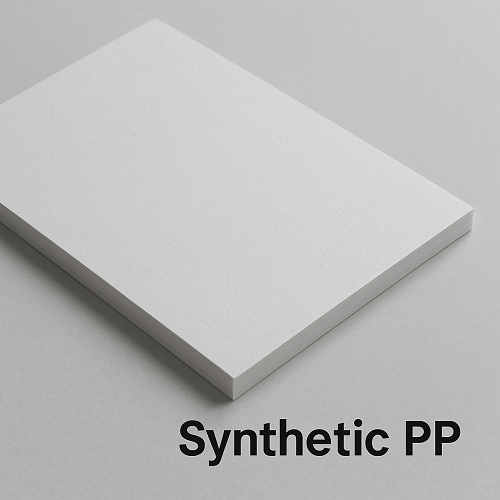
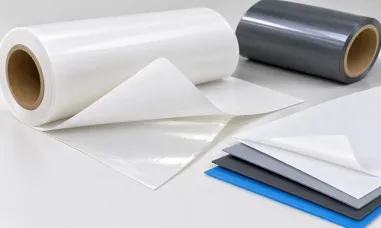
The name is slightly misleading. Synthetic PP release paper contains no cellulose fiber in the usual sense. It is a polypropylene (PP) film, a thermoplastic polymer, that is coated with a silicone layer so that adhesives, sealants and other tacky materials can be peeled away cleanly. In pressure-sensitive products this silicone-coated carrier is called a release liner. It protects the adhesive until the moment of application. For background on the base polymer, see the general overview of polypropylene on Wikipedia and the entry on release liners.
Because the substrate is a polymer film rather than a fibrous sheet, it behaves differently from paper in three ways that matter on the production floor. It does not absorb water, it does not tear easily under tension, and it holds its dimensions when temperature and humidity change. The manufacturer's own Synthetic PP product page describes these as the core properties of its release material.
The Technical Properties That Drive Adoption
Dimensional stability
Paper liners take up and lose moisture, so they can curl, wave or shrink between the warehouse and the press. A PP film liner largely avoids this. For converters running registration-sensitive work such as die-cutting, laminating or multi-pass printing, a stable liner means fewer registration errors and less rework.
Moisture and chemical resistance
PP is hydrophobic, so the liner does not swell or degrade in humid warehouses, cold-chain storage or outdoor exposure. The supplier also describes the film as water- and oil-repellent and resistant to a range of chemicals, which matters for construction tapes, sealants and some industrial adhesives.
Tear and puncture resistance
High tensile and tear strength matter most in high-speed die-cutting and matrix stripping. A liner that snaps when the waste matrix is pulled away stops the line. A tougher film keeps webs running and allows thinner gauges for the same performance, which is one reason PP liners are described as lightweight despite their strength.
Smooth surface and consistent release
The film's uniformly smooth surface suits silicone coating. A clean, even silicone layer produces stable release force across a wide temperature range. In automated dispensing or labeling, an unstable release force shows up as labels that fail to feed or liners that tear on peel, so consistency is a practical requirement rather than a nicety.
Recyclability
The supplier describes the material as recyclable and notes that thinner liners reduce total plastic use per unit. It is worth being precise here. Recyclability in practice depends on local collection and sorting systems and on contamination from silicone and adhesive residue. Buyers with sustainability targets should ask about liner take-back or recycling programs in their region instead of assuming a recycling outcome.
Synthetic PP vs. Paper and PET Liners: A Practical Comparison
The table below is a qualitative guide for early-stage material selection. It reflects general material behavior and the properties stated by the supplier, not guaranteed values. Exact figures such as caliper, tensile strength and release force depend on the specific grade and silicone system, and should be confirmed against a technical data sheet.
| Criterion | Synthetic PP film liner | Paper-based liner (e.g., glassine, PE-coated paper) | PET film liner |
|---|---|---|---|
| Moisture behavior | Does not absorb water | Moisture-sensitive; can curl or wave | Does not absorb water |
| Tear resistance | High | Lower; varies by grade | High tensile strength |
| Dimensional stability | Good across temperature and humidity changes | Affected by humidity | Very good, often better under heat |
| Surface for silicone coating | Smooth and uniform | Depends on the sealing or coating layer | Smooth and uniform |
| Weight and flexibility | Lightweight and flexible | Varies; often stiffer at equal strength | Lightweight; typically stiffer than PP |
| Typical fit | Moisture-prone, high-speed or precision converting | General-purpose, cost-driven labeling | Heat-intensive or very tight-tolerance processes |
Note: Comparative ratings are general industry characterizations and the supplier's stated properties. Confirm values for your application with a technical data sheet and your own trials.
Where Synthetic PP Release Liners Are Used
According to the supplier, the material is used across several sectors:
- Healthcare: carrier liners for medical tapes, wound dressings and transdermal patches, where cleanliness and stability matter.
- Automotive and industrial tapes: double-sided and foam tapes used in assembly, which need to peel cleanly after long storage or exposure to heat.
- Printed graphics and signage: backing for pressure-sensitive films, vinyl graphics and screen-printed products, helping prevent adhesive transfer during application.
- Labelstock and converting: release film for pressure-sensitive labels, where consistent thickness supports high-speed die-cutting and matrix stripping.
- Construction materials: protective films, sealants and waterproof tapes exposed to outdoor conditions and chemicals.
Regulated uses deserve extra care. A liner for a medical or transdermal product is not qualified by its material type alone. The adhesive, the silicone system and the finished product all need to meet the relevant regulations and the end customer's specification.
How to Specify a Synthetic PP Liner: A Buyer's Checklist
Material selection goes more smoothly when the requirements are written down before any samples are requested. The following points are worth settling with your supplier:
- Adhesive type. Acrylic, rubber-based and silicone adhesives interact differently with a given silicone release coating, so the target release force should be stated for your specific adhesive.
- Process temperature. Note the highest temperature the liner will see during coating, drying, lamination or end use. PP has a lower heat tolerance than PET, so very hot processes need a clear check.
- Converting method. Die-cutting, kiss-cutting, slitting and printing each place different demands on thickness, stiffness and surface.
- Storage and shelf life. Ask how release force is expected to change with aging in your storage conditions.
- Test methods. Agree on standard test procedures for release force and related properties. Industry methods are published by FINAT, the European association for the self-adhesive label industry.
- Sustainability goals. If recyclability or reduced plastic use is a target, ask about liner gauge options and regional recycling routes.
Limitations Worth Knowing
No single liner suits every job. Synthetic PP gives up some heat resistance compared with PET, and film liners generally cost more per square meter than commodity paper liners. For low-risk, dry-environment labeling at moderate speeds, a paper liner may still be the better economic choice. The case for PP is strongest where moisture, repeated handling, tight tolerances or high line speeds make liner failure expensive. Running a pilot trial on your own equipment is the most reliable way to confirm the fit.
About the Supplier
The material discussed here is offered by Zhejiang Wanbaolong Adhesive Products Co., Ltd., which presents itself on its website as a manufacturer of adhesive-product materials. You can learn more about its background on the About Us page, including the company profile and the Baoda brand. Production capacity and logistics are covered on the Factory Base and Global Network pages.
Synthetic PP sits within a wider product range. Buyers comparing substrates may also want to review the Lightweight Film Series, the Durable Film Series, the Paper Series and the PE-coated paper and silicone paper series. Related film products include Transparent PET, Bright Silver BOPP and Glossy White PET (Coating). Further updates are posted under Industry News and Company News. The company also lists a storefront on Alibaba.com.
Get Technical Advice Before You Order
For help choosing a grade, the supplier's technical support team can be reached through the Contact page. When you write, include your adhesive type, converting method, operating temperature range and target volumes so the team can recommend suitable options and arrange samples.
- Email: wbl.fred@gmail.com or huangcy921126@gmail.com
- Phone: 0086-0573-8789 5888 / 87896955 / 87896899, or +86-19975380486
- Website: en.wbllabel.com/synthetic-pp.html
Frequently Asked Questions
Is Synthetic PP the same as ordinary paper with a plastic coating?
No. Synthetic PP release paper is a polypropylene film with a silicone release coating. It has no fibrous paper core, which is why it resists water and tearing.
Can it replace PET liners?
In many applications, yes, particularly where flexibility and lighter weight help. For processes with very high heat, PET may still be the safer choice. Validate with trials.
Does it suit high-speed converting?
The supplier states that its tear strength and consistent thickness suit high-speed die-cutting and matrix stripping. Actual performance depends on your equipment and settings.